Music and Stuff adrianhowe.blogspot.com is my personal blog about music i like (bands and solo singers old and new!) also about equipment old and new and what im up too musically and otherwise. discussions and comments are welcomed. so come join in. :)
Wednesday, 19 March 2014
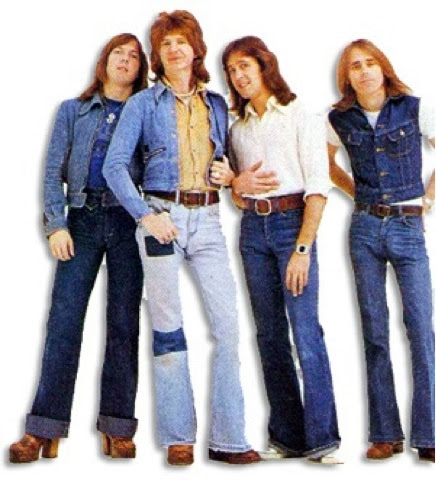
Smokie.
Wednesday, 5 March 2014
Ted Mulry Gang.
Ted Mulry first came to the attention of the music industry when he sent a demo of some of his own compositions to Albert Productions inSydney. He was persuaded to be recorded himself and soon rose to fame as a solo singer/songwriter with his own composition, the pop ballad "Julia", which made the Australian charts in 1970. He then went on to score a major hit with The Easybeats songwriting team,Harry Vanda & George Young song, "Falling In Love Again" in 1971. He was a prolific songwriter and a number of bands and artists, such as John Farnham and Alison MacCallum, recorded his songs, the most notable being rock band Sherbet, who had a hit with his song, "You're All Woman". He travelled to England briefly in 1972 and recorded one single there under the name Steve Ryder but returned to Australia soon after. During his time as a solo artist he released two albums, Falling In Love Again and I Won't Look Back.
Ted Mulry Gang After getting tired of being backed by different backing bands, in 1972 he switched from acoustic guitar to bass and formed his own band, Ted Mulry Gang, with guitarist Les Hall & drummer Herman Kovac. The band signed a recording deal with Albert Productions in 1974 and released their first album Here We Are. When that album didn't do as well as expected, the record company wanted Mulry to go back to singing solo. Ronnie Clayton told them to stick to it and brought in second guitarist Gary Dixon to complete the foursome. With his own band behind him he adopted a more hard rocking style.
Their first major hit, and the biggest of their career was the 1975 single "Jump in My Car" which spent 6 weeks at number one on the Australian singles charts in 1976. It was the second single released from the Here We Are album produced by John L Sayers at Trafalgar Studios. Over the next few years they achieved a string of hit singles including a rocked up version of the old jazz song, "Darktown Strutters' Ball", "Crazy", "Jamaica Rum" and "My Little Girl". Many of TMG's songs, including "Jump In My Car", were co-written with guitarist Les Hall. By late 1980 their chart success had ended but they remained popular performers on the Australian pub circuit. In 1989, after some time apart, the Ted Mulry gang reformed, releasing the album "Re-Union" for Albert, on Sony. This release also marked the first release of the Ted Mulry Gang on compact disc. Other CD reissues would follow in the early 90's.
In 1998 Ted released a solo CD called This Time featuring songs co-written by himself and his brother Steve Mulry. In early 2001 Ted Mulry announced that he had been diagnosed with terminal brain cancer. Gimme Ted, a series of tribute concerts organized shortly before his death, brought together an assortment of Australian rock acts of his era to pay tribute to him. These included a reunion of his band Ted Mulry Gang with his brother Steve Mulry standing in for him as lead vocalist. Steve now fronts the rock band Black Label and performs at many venues, around New South Wales and Victoria, often supporting bands such as The Angels.
In January 2006, David Hasselhoff recorded a version of Ted's classic "Jump In My Car' whilst in Australia. Hasselhoff's version was subsequently released in the UK and went to #3 in the charts there in October 2006.
Tuesday, 4 March 2014
Skyhooks
Skyhooks were an Australian rock band formed in Melbourne in March 1973 by mainstaysGreg Macainsh on bass guitar and backing vocals, and Imants "Freddie" Strauks ondrums. They were soon joined by Bob "Bongo" Starkie on guitar and backing vocals, and Red Symons on guitar, vocals and keyboards; Graeme "Shirley" Strachan became lead vocalist in March 1974. Described as a glam rock band, because of flamboyant costumes and make-up, Skyhooks addressed teenage issues including buying drugs ("Carlton (Lygon Street Limbo)"), suburban sex ("Balwyn Calling"), the gay scene ("Toorak Cowboy") and loss of girlfriends ("Somewhere in Sydney") by namechecking Australian locales. According to music historian, Ian McFarlane "[Skyhooks] made an enormous impact on Australian social life".
Skyhooks had #1 albums on the Australian Kent Music Report with their 1974 debut, Living in the 70's (for 16 weeks), and its 1975 follow-up, Ego Is Not a Dirty Word (11 weeks). Their #1 singles were "Horror Movie" (January 1975), "Ego Is Not a Dirty Word" (April 1975) and "Jukebox in Siberia" (November 1990).
Symons left Skyhooks in 1977 and became a radio and television personality. Strachan had solo releases since 1976 and finally left the band in 1978 and was also a radio and television presenter. With altered line-ups, Skyhooks continued until they disbanded on 8 June 1980; they briefly reformed in 1983, 1984, 1990 and 1994. In 1992, Skyhooks were inducted into the Australian Recording Industry Association (ARIA) Hall of Fame. Lead singer, Strachan died on 29 August 2001, aged 49, in a helicopter crash while solo piloting. Their original lead singer, Steve Hill, died in October 2005, aged 52, of liver cancer.
In 2011, the Skyhooks album Living in the 70s was added to the National Film and Sound Archive of Australia's Sounds of Australiaregistry.
Wednesday, 27 November 2013
The Sweet! PT1....
Sweet (also referred to as The Sweet) were a British rock band that rose to worldwide fame in the 1970s as a prominent glam rock act, with their most prolific line-up: lead vocalist Brian Connolly, bass player Steve Priest, guitarist Andy Scott, and drummerMick Tucker.
Sweet were formed in 1968 and achieved their first hit "Funny Funny" in 1971 after teaming up with songwriters Nicky Chinn and Mike Chapman and record producer Phil Wainman. During 1971 and 1972, their musical style followed a marked progression from the Archies-like bubblegum style of "Funny Funny" to a Who-influenced hard rock style supplemented by a striking use of high-pitched backing vocals.
The band achieved notable success in the UK charts, with thirteen Top 20 hits during the 1970s alone, with "Block Buster!" (1973) topping the chart, followed by three consecutive number two hits in "Hell Raiser" (1973), "The Ballroom Blitz" (1973) and "Teenage Rampage" (1974). the band turned to more Hard Rock style with their mid-career singles like 1974's Turn It Down. Their first self-written and produced single "Fox on the Run" (1975) also reached number two on the UK charts. These results were topped in West Germany and other countries on the European mainland, where the band was very popular.
The Sweet had their last Top 10 hit in 1978 with "Love Is Like Oxygen". Connolly left the group in 1979 to start a solo career and the remaining members continued as a threesome until disbanding in 1981.
Since the mid-1980s, Scott, Connolly and Priest have each played with their own versions of Sweet during different periods of time. Connolly died in 1997, and Tucker died in 2002. The two surviving members are still active in their respective versions of the band; Scott's is based in the United Kingdom and Priest's in the United States.