Showing posts with label Countdown. Show all posts

Wednesday, 12 March 2014

John Farnham

                                                                    John Farnham.

John Peter Farnham AO, formerly billed as Johnny Farnham (born 1 July 1949,Dagenham, England), is an Australian pop singer. Formerly billed as Johnny Farnham he was a teen pop idol from 1964 to 1979, and has since forged a career as an adult contemporary singer.   His career has mostly been as a solo artist although he briefly replaced Glenn Shorrock as lead singer of Little River Band during 1982–1985.    In September 1986 his solo single, "You're the Voice" peaked at No. 1 on the Australian singles charts.  The associated album, Whispering Jack, held the No. 1 position for a total of 25 weeks,   and is the highest-selling album in Australian history.   Both the single and the album had Top Ten success internationally including No. 1 in Sweden.

Domestically he has remained one of Australia's best-known performers with a career spanning over 40 years,   and he is the only Australian artist to have a number one record in five consecutive decades with singles: "Sadie (The Cleaning Lady)" in 1967, "Raindrops Keep Fallin' on My Head" in 1969/1970, and "Age of Reason" in 1988;   and albums: Age of Reason, Chain Reaction in 1990, Then Again... in 1993, Anthology 1: Greatest Hits 1986-1997 in 1997, 33⅓ in 2000 and The Last Time in 2002. 

Farnham has been recognised by honours and awards including 1987 Australian of the Year, 1996 Officer of the Order of Australia, and 19 Australian Recording Industry Association (ARIA) Awards including his 2003 induction into the Hall of Fame.   From 1969 he was voted by TV Week readers as the 'King of Pop' for five consecutive years.  Aside from his recording career, Farnham performed on stage with lead roles in Australian productions of Charlie Girl, Pippin and 1992's Jesus Christ Superstar.   He starred in his own TV series and specials including It's Magic andBobby Dazzler and as a guest on numerous other popular shows such as Countdown andHey Hey It's Saturday.   Australian rock historian, Ian McFarlane described him as "the most successful solo artist in the history of Australian rock and pop. Farnham has retained an affable sense of humour and a simple, unpretentious 'everyman' charm which also makes him one of the most respected celebrities in Australian entertainment history." 


Wednesday, 5 March 2014

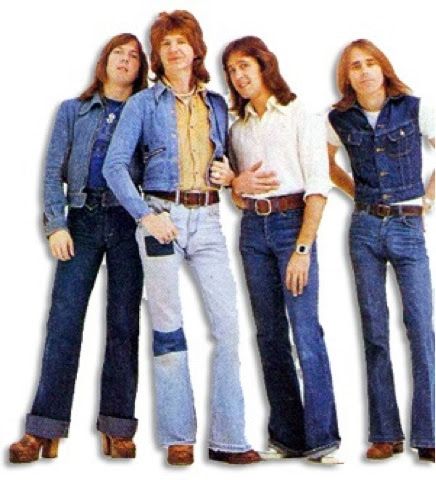
Ted Mulry Gang.

                                                                    Ted Mulry Gang.

Ted Mulry first came to the attention of the music industry when he sent a demo of some of his own compositions to Albert Productions inSydney. He was persuaded to be recorded himself and soon rose to fame as a solo singer/songwriter with his own composition, the pop ballad "Julia", which made the Australian charts in 1970. He then went on to score a major hit with The Easybeats songwriting team,Harry Vanda & George Young song, "Falling In Love Again" in 1971. He was a prolific songwriter and a number of bands and artists, such as John Farnham and Alison MacCallum, recorded his songs, the most notable being rock band Sherbet, who had a hit with his song, "You're All Woman". He travelled to England briefly in 1972 and recorded one single there under the name Steve Ryder but returned to Australia soon after. During his time as a solo artist he released two albums, Falling In Love Again and I Won't Look Back.

Ted Mulry Gang        After getting tired of being backed by different backing bands, in 1972 he switched from acoustic guitar to bass and formed his own band, Ted Mulry Gang, with guitarist Les Hall & drummer Herman Kovac. The band signed a recording deal with Albert Productions in 1974 and released their first album Here We Are. When that album didn't do as well as expected, the record company wanted Mulry to go back to singing solo.  Ronnie Clayton told them to stick to it and brought in second guitarist Gary Dixon to complete the foursome. With his own band behind him he adopted a more hard rocking style.

Their first major hit, and the biggest of their career was the 1975 single "Jump in My Car" which spent 6 weeks at number one on the Australian singles charts in 1976. It was the second single released from the Here We Are album produced by John L Sayers at Trafalgar Studios. Over the next few years they achieved a string of hit singles including a rocked up version of the old jazz song, "Darktown Strutters' Ball", "Crazy", "Jamaica Rum" and "My Little Girl". Many of TMG's songs, including "Jump In My Car", were co-written with guitarist Les Hall. By late 1980 their chart success had ended but they remained popular performers on the Australian pub circuit. In 1989, after some time apart, the Ted Mulry gang reformed, releasing the album "Re-Union" for Albert, on Sony. This release also marked the first release of the Ted Mulry Gang on compact disc. Other CD reissues would follow in the early 90's.

In 1998 Ted released a solo CD called This Time featuring songs co-written by himself and his brother Steve Mulry. In early 2001 Ted Mulry announced that he had been diagnosed with terminal brain cancer. Gimme Ted, a series of tribute concerts organized shortly before his death, brought together an assortment of Australian rock acts of his era to pay tribute to him. These included a reunion of his band Ted Mulry Gang with his brother Steve Mulry standing in for him as lead vocalist. Steve now fronts the rock band Black Label   and performs at many venues, around New South Wales and Victoria, often supporting bands such as The Angels.

In January 2006, David Hasselhoff recorded a version of Ted's classic "Jump In My Car' whilst in Australia. Hasselhoff's version was subsequently released in the UK and went to #3 in the charts there in October 2006.


Tuesday, 4 March 2014

Skyhooks

                                                                        Skyhooks.

Skyhooks were an Australian rock band formed in Melbourne in March 1973 by mainstaysGreg Macainsh on bass guitar and backing vocals, and Imants "Freddie" Strauks ondrums. They were soon joined by Bob "Bongo" Starkie on guitar and backing vocals, and Red Symons on guitar, vocals and keyboards; Graeme "Shirley" Strachan became lead vocalist in March 1974. Described as a glam rock band, because of flamboyant costumes and make-up,  Skyhooks addressed teenage issues including buying drugs ("Carlton (Lygon Street Limbo)"), suburban sex ("Balwyn Calling"), the gay scene ("Toorak Cowboy") and loss of girlfriends ("Somewhere in Sydney") by namechecking Australian locales. According to music historian, Ian McFarlane "[Skyhooks] made an enormous impact on Australian social life".

Skyhooks had #1 albums on the Australian Kent Music Report with their 1974 debut, Living in the 70's (for 16 weeks), and its 1975 follow-up, Ego Is Not a Dirty Word (11 weeks).  Their #1 singles were "Horror Movie" (January 1975), "Ego Is Not a Dirty Word" (April 1975) and "Jukebox in Siberia" (November 1990). 

Symons left Skyhooks in 1977 and became a radio and television personality. Strachan had solo releases since 1976 and finally left the band in 1978 and was also a radio and television presenter.  With altered line-ups, Skyhooks continued until they disbanded on 8 June 1980; they briefly reformed in 1983, 1984, 1990 and 1994.   In 1992, Skyhooks were inducted into the Australian Recording Industry Association (ARIA) Hall of Fame.  Lead singer, Strachan died on 29 August 2001, aged 49, in a helicopter crash while solo piloting. Their original lead singer, Steve Hill, died in October 2005, aged 52, of liver cancer.

In 2011, the Skyhooks album Living in the 70s was added to the National Film and Sound Archive of Australia's Sounds of Australiaregistry. 


Sunday, 9 February 2014

Countdown.

                                                                    Countdown.

Countdown was a long-running popular weekly Australian music television show broadcast by the Australian Broadcasting Corporation from 8 November 1974 until 19 July 1987. It was created by Executive Producer Michael Shrimpton, producer/director Robbie Weekes and record producer and music journalist Ian "Molly" Meldrum. Countdown was produced at the studios of the ABC in the Melbourne suburb ofRipponlea.

Countdown was the most popular music program in Australian TV history. It was broadcast nationwide on Australia's government-owned broadcaster, the ABC and commanded a huge and loyal audience. It soon exerted a strong influence on radio programmers because of its audience and the amount of Australian content it featured. For most of the time it was on air, it also gained double exposure throughout the country by screening a new episode each Sunday evening, and then repeating it the followingSaturday evening. The majority of performances on the show were lip synched.

Molly Meldrum, the program's talent co-ordinator, began appearing on-air in 1975, presenting the Humdrum music news segment and conducting interviews. Molly soon became the "face" of Countdown. He appeared regularly on-air until 1986. Another attraction to the program was the local and international acts who would host an episode - usually performing as well. During the show, Molly would interview them (while co-hosting) or have a chat with them before the show went out with the number 1 single of the week.


Many international acts who would otherwise have gone largely unheard on Australian commercial radio, gained important exposure in Australia on
 Countdown through their music videos; the list includes many UK "New Wave" acts, such as XTC, The Beat, Elvis Costello, The Specials, Lene Lovich, Joe Jackson, and The Cure, and US acts such as The Ramones and The Cars.Although it is not widely recognised, Countdown also had a strong international influence, because it was one of the first TV shows in the world to promote the regular use of the music video as a major part of its programming. Because of its receptivity to music videos (something of a necessity because of the comparative rarity of tours by overseas acts) Countdown proved to be instrumental in the worldwide success of a number of important overseas acts of the period. Madonna achieved her first hit single in April 1984 when "Holiday" was screened on Countdown. Subsequently "Burning Up" reached the top twenty following repeated showings of the video clip on the show; this second song was not a hit in other countries. Other international artists including Blondie, ABBA, John Mellencamp, Meat Loaf, Boz Scaggs and Cyndi Lauper achieved their first hits in Australia, thanks to their video clips being aired onCountdown, and this in turn led to their records being picked up and becoming hits in America and/or Europe.

Above all, Countdown was crucial to the success of many leading Australian acts, including AC/DC, Olivia Newton-John, INXS, Hush (band) Kylie Minogue, I'm Talking, John Paul Young, Sherbet, Skyhooks, Marcia Hines, Mark Holden, The Angels, Mondo Rock, Men at Work, Icehouse, Australian Crawl, Mental As Anything, Little River Band, William Shakespeare, Renée Geyer, Wa Wa Nee and Jon English.

The program dominated Australian popular music well into the 1980s, although some critics felt  that in later years it tended to concentrate on pop-oriented major-label acts and that it failed to reflect much of the exciting independent scene of the time.

The popularity of Countdown was losing momentum by the mid-1980s. Music videos were often shown, rather than the artists performing live in the studio. It was cheaper to produce with videos and this led to Countdown having no significant difference from any other music video program shown on TV during this time.

The final episode of Countdown aired on 19 July 1987, followed by the Countdown Awards. It was a sad night for many, yet a celebration of musical achievements in '86/'87. Molly made his appearance at the end of the show wearing his well known, and internationally recognised, Akubra hat. Molly saluted the music industry and fans and then bared his shaved head to the audience. It was well known that his shaved head was a statement to artists like Midnight Oil, who during their career and being one of Australia's favourite bands, never appeared on the show because they often regarded Countdown as too industry/hit driven and appealed only to a young teenage audience.

In March 2007, pay television channel Foxtel, and its regional affiliate Austar, began screening hundreds of studio performances from the Countdown era. Themed Countdown specials have become very popular and lost performances by John Farnham, drag queen Divine, a-ha, Pseudo Echo and the Countdown Dancers performing the Flashdance medley highlight the great music of the period.

                                     http://m.youtube.com/watch?autoplay=1&v=wn6dVnVuLOc&desktop_uri=%252Fwatch%253Fv%253Dwn6dVnVuLOc%2526autoplay%253D1